Applicable Standards and What to Verify Before Specifying a Cable
Regulations and Product Families

STANDARD CABLETEAM · BEYOND STANDARD
What standards apply to a cable, and why are the references provided for guidance only?
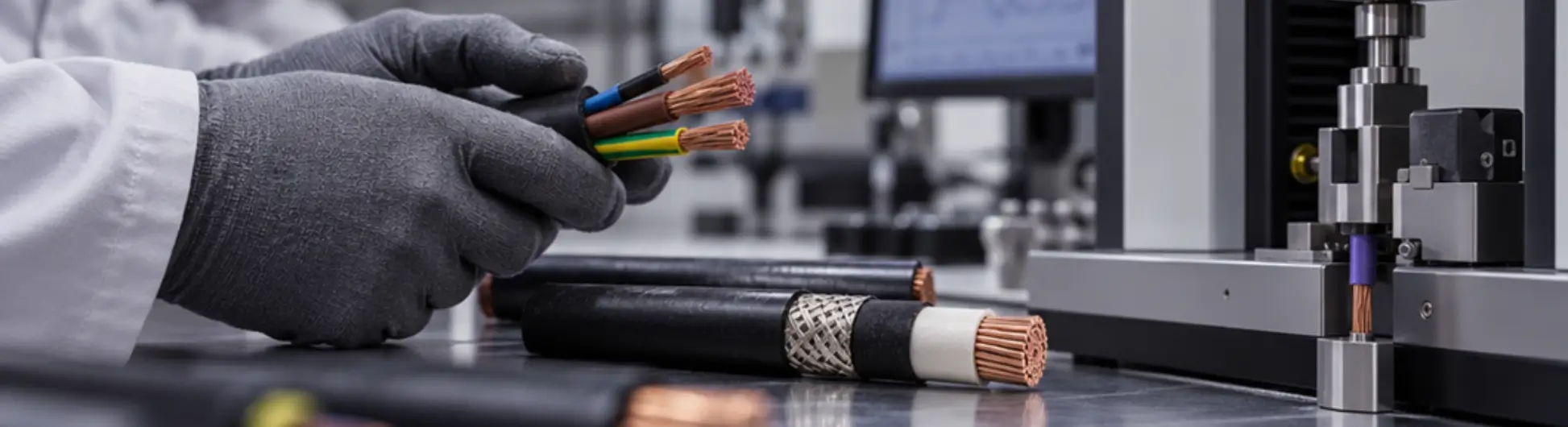
A cable is not defined by a single standard, but rather by a combination of three elements: the product standard for its family (construction and characteristics), the testing standards (methods and acceptance criteria), and the regulatory requirements of the location of use and of the customer or operator. The references we provide for each family serve as the standard starting point. They are for guidance only because the current edition of the standard, the target market, and the project specifications may add, replace, or tighten requirements. For this reason, before designing and manufacturing, Standard CableTeam confirms the final specifications with the customer.
What information does Standard CableTeam need to correctly specify a cable?
In all cases, we need three categories of information: the application (what function the cable serves and in which system), the environment (installation, temperature, chemicals, UV radiation, humidity, and mechanical stresses), and the regulatory framework (applicable standards, local regulations, and operator or project requirements). Each product family also requires specific data, which is detailed in the following questions.
Product Standard
Construction and Characteristics
Testing Standards
Methods and Acceptance Criteria
Project Requirements
Local Regulations and Operator Requirements
What is the difference between fire reaction and circuit integrity?
Fire reaction describes how the cable behaves as a combustible material: whether it spreads flames, how much heat it releases, how much smoke it generates, and how acidic or corrosive the gases it emits are. Circuit integrity describes whether the cable continues to function while the surrounding area is on fire—that is, whether it maintains power supply or signal transmission for a specified period of time.
These are independent properties: a cable can have excellent fire reaction but fail to maintain circuit integrity, or vice versa. Safety systems, such as emergency lighting, smoke detection, or smoke extraction, typically require both.
REGULATIONS AND PRODUCT FAMILIES / 01
Energy and Control
Current Carrying Capacity
Installation Method
Voltage Drop
Circuit Length
Short-Circuit Resistance
Thermal Behaviour
What standards apply to power and control cables?
The standard references for this category are:
IEC 60227: PVC-insulated cables with a rated voltage up to and including 450/750 V.
IEC 60245: rubber (elastomer)-insulated cables rated up to and including 450/750 V.
UNE-EN 50525: low-voltage electrical cables rated up to and including 450/750 V, the reference European standard in this range.
IEC 60502-1: power cables with extruded insulation for rated voltages of 1 kV and 3 kV.
IEC 60228: conductor classes: Class 1 (rigid), Class 2 (wiring), and Classes 5 and 6 (flexible).
What information is required to specify a power or control cable?
Three data blocks must be completed. Voltage: rated voltage U0/U and maximum system voltage, current type (AC or DC), and frequency. Construction: conductor material and cross-sectional area, and its class according to IEC 60228; number of conductors; insulation material (PVC, XLPE, EPR, silicone, or halogen-free compounds); shields, armors, and outer sheath. Installation: fixed or mobile installation; in a cable tray, conduit, buried, or exposed to the elements; ambient and operating temperatures; and exposure to oils, UV radiation, or abrasion.
How is the cross-sectional area of a power cable determined?
Three criteria are verified simultaneously: the permissible current based on the installation method (for example, in accordance with IEC 60364-5-52), the permissible voltage drop along the circuit, and the thermal resistance to short circuits. The cross-sectional area that meets all of these criteria is selected. The type of service and mechanical strength may also require a minimum cross-sectional area.
What is the difference between a Class 2 conductor and a Class 5 conductor?
According to IEC 60228, Class 2 is a stranded conductor designed for fixed installations. Class 5 is flexible, with thinner strands, and is intended for flexible or moving installations; Class 6 is even more flexible. The class determines the permissible bending radius, resistance to flexural fatigue, and ease of connection.
REGULATIONS AND PRODUCT FAMILIES / 02
Copper Data
What standards apply to copper data cables?
The standard references for this family are:
IEC 61156: multi-conductor cables and symmetrical twisted-pair or quad cables for digital communications, specifying the transmission characteristics for each category.
ISO/IEC 11801: generic cabling for customer premises: defines channel classes and component categories.
TIA/EIA-568: telecommunications cabling for commercial buildings; the primary standard in North America.
EN 50173: generic cabling systems in Europe, aligned with ISO/IEC 11801.
What specifications are required to define a copper data cable?
Four specifications must be defined. Category: Cat 5e, 6, 6A, 7, 7A, or 8. Frequency: the associated bandwidth, which is 100 MHz for Cat 5e, 250 MHz for Cat 6, 500 MHz for Cat 6A, 600 MHz for Cat 7, 1000 MHz for Cat 7A, and 2000 MHz for Cat 8. Length: The standard channel length is 100 m, and for Cat 8, it is limited to 30 m. Channel: Link configuration, number of connections, and shielding type (U/UTP, F/UTP, U/FTP, or S/FTP). The fire resistance rating of the jacket must also be specified.
What is the difference between category and class in structured cabling?
Category applies to components (cable, connectors, patch cords), and class applies to the entire channel or link. In ISO/IEC 11801, Class D corresponds to Cat 5, Class E to Cat 6, Class EA to Cat 6A, Class F to Cat 7, Class FA to Cat 7A, and Classes I and II to Cat 8.1 and 8.2. TIA/EIA-568 does not define Cat 7 or Cat 7A.
What transmission parameters are tested in a data cable?
The following parameters are tested: attenuation, crosstalk (NEXT and PS NEXT), back-crosstalk (ACR-F and PS ACR-F), return loss, DC resistance and its imbalance, propagation delay, and pair-to-pair delay difference (skew). In higher-bandwidth categories, such as Category 6A, alien crosstalk is also tested. The standard for each category specifies the frequency-dependent limits.
Does Power over Ethernet (PoE) affect the choice of cable?
Yes. With high-power PoE (IEEE 802.3bt), current flows through all four pairs, and the heat generated by the cable bundle increases with ambient temperature and cable density, which increases attenuation. It is advisable to confirm the expected power, conductor cross-section, outer diameter, and operating temperature to ensure adequate margin when selecting cable size.
REGULATIONS AND PRODUCT FAMILIES / 03
Optical Fiber
Rolling Stock
Short distances - 850 nm
OM3 2000 MHz·km
OM4 4700 MHz·km
Single-mode
Long distances
1310 and 1550 nm
Backbone and access networks
What standards apply to fiber-optic cables?
The standard references for this family are:
IEC 60793: Optical fibers: Specifications for multimode and single-mode fibers.
IEC 60794: optical fiber cables: generic and family-specific specifications (indoor, outdoor, aerial, and microduct) and test methods.
IEC 61300: fiber-optic interconnection devices and passive components: basic test and measurement procedures.
Telcordia GR-20-CORE: generic requirements for fiber and fiber-optic cable, commonly used in the North American telecommunications market.
What information is needed to specify a fiber-optic cable?
Four categories must be specified. Fiber: multimode (OM1 to OM5) or single-mode (OS1 or OS2, including bend-resistant versions), and number of fibers. Construction: loose tube, tight-buffered, ribbon, central tube, or microcable, with the necessary moisture protection, rodent protection, or armoring. Environment: indoor or outdoor, conduit, aerial or buried, temperature range, and fire resistance. Connectivity: connector type (LC, SC, MPO), polish type (UPC or APC), and whether pre-assembly or field splicing is required.
When should you use multimode fiber, and when should you use single-mode fiber?
Multimode fiber is used for short distances, such as in data centers, buildings, and campuses, with 850-nm VCSEL sources; OM3 and OM4 fibers are optimized for lasers, with effective modal bandwidths of 2,000 and 4,700 MHz·km, respectively. Single-mode fiber is used for long distances and high capacities (backbone, metropolitan, and access networks) in the 1310 and 1550 nm windows.
What is the difference between a loose-tube cable and a tight-structure cable?
In a loose-tube cable, the fibers are housed loosely inside tubes filled with a moisture-resistant compound (gel or dry), which insulates them from mechanical stress and thermal expansion of the cable; this is the standard solution for outdoor use, in conduits, and for aerial installations. In a tight-structured cable, each fiber has a tight secondary coating of 900 µm, resulting in a more compact cable that is easier to terminate; this is the standard solution for indoor use, in risers, and in patch cords.
What fire safety requirements apply to a fiber-optic cable?
Indoor fiber-optic cables are specified based on their fire performance, typically with halogen-free jackets and low smoke emission, and, in Europe, with a fire reaction class in accordance with the Construction Products Regulation. If the cable is part of an emergency circuit, circuit integrity may also be required, as verified by IEC 60331-25.
REGULATIONS AND PRODUCT FAMILIES / 04
Railroad
Rolling Stock
Power - control - data
EN 50264 - EN 50306
EN 45545-2
Infrastructure
Signalling - power supply
Tunnels - stations
Operator requirements
What standards apply to railway cables?
The standard references for this family are:
EN 50264: power and control cables for railway rolling stock with special fire performance.
EN 50305: test methods for rolling stock cables with special fire performance.
EN 50306: thin-walled cables for rolling stock with special fire performance.
EN 45545: fire protection in railway vehicles; Part 2 establishes fire performance requirements for materials and components based on the risk level (HL1 to HL3).
What needs to be confirmed when specifying a railway cable?
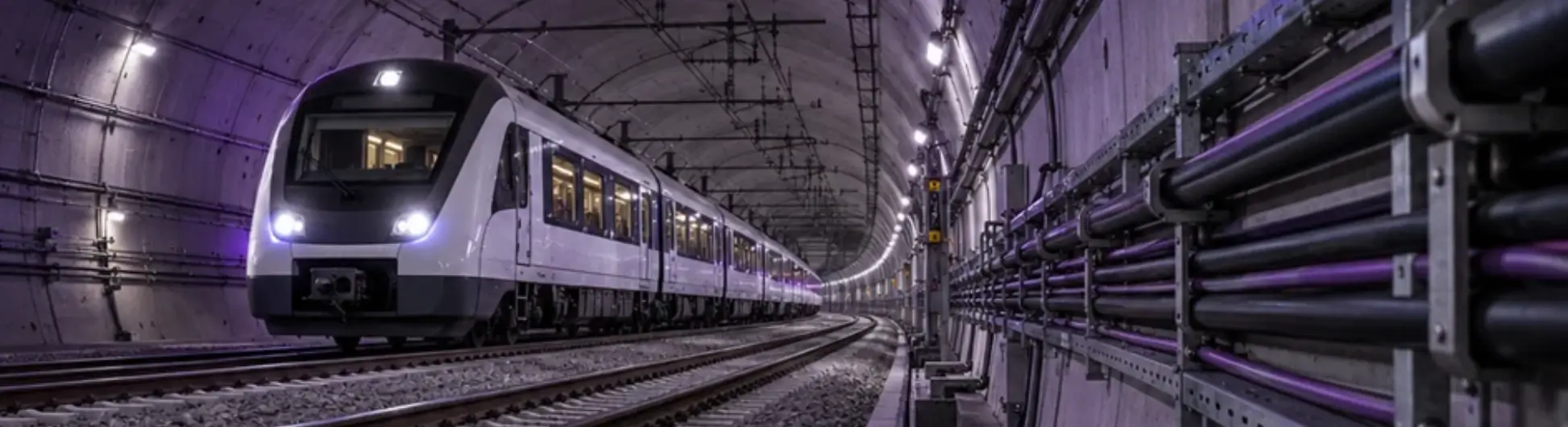
Two categories must be defined. Vehicle or infrastructure: whether the cable is installed on rolling stock (traction, auxiliary, control, data; inside or outside the vehicle; bogie) or on infrastructure (signaling, power, tunnels, stations), because the applicable standards and requirements differ. Operator requirements: specific specifications, HL risk level, system voltage, temperature range, expected service life, and exposure to fluids.
What is the HL risk level in the EN 45545-2 standard?
It is the fire performance requirement level assigned to a vehicle: HL1, HL2, or HL3, from lowest to highest requirement. It is determined based on the operating category (1 through 4, depending on the type of route—for example, open road, tunnels, or elevated structures—and the possibilities for lateral evacuation) and the design category (A, B, C, or D, depending on the type of vehicle). The more difficult it is to evacuate, the higher the HL level required for materials and cables.
What operating conditions must a railway cable withstand?
It must withstand continuous vibrations and shocks, wide temperature cycles, exposure to oils, fuels, and cleaning agents, ozone and UV radiation, and abrasion. If the cable transmits signals or powers sensitive equipment, electromagnetic compatibility requirements (EN 50121 series) apply. In the event of a fire, it must emit low levels of smoke and non-halogenated gases. When vehicle weight is a critical factor, thin-wall constructions compliant with EN 50306 are used.
REGULATIONS AND PRODUCT FAMILIES / 05
Fire - Reaction
Flame
Flame spread
Heat
Heat release
Smoke
Smoke density
Gases
Acidity and corrosivity
Droplets
Flaming droplets and particles
What standards are used to evaluate a cable’s reaction to fire?
The standard references are:
IEC/UNE-EN 60332-1: vertical flame spread in a single insulated cable or conductor.
IEC 60332-3: vertical flame spread in vertically mounted cable bundles, with categories based on the volume of non-metallic material per meter.
IEC 60754: gases emitted during combustion: halogenated acid gas content (Part 1) and acidity and conductivity (Part 2).
IEC 61034: Measurement of smoke density from burning cables in a 3 m³ chamber.
ISO 4589: Oxygen index of plastic materials.
What information must be specified to define a cable’s reaction to fire?
Four pieces of information must be specified. Phenomenon: what is to be limited (flame spread, heat release, smoke, acidity or corrosiveness of gases, burning droplets). Installation: whether the cable is installed individually or in bundles, and the number of cables per meter of cable tray. Classification: the class or level required by the standard or specifications. Market: the country of destination, because each set of regulations defines its own classes and tests.
What is the difference between IEC 60332-1 and IEC 60332-3?
IEC 60332-1 tests a single cable placed vertically with a 1-kW flame and represents the basic level of flame non-propagation. IEC 60332-3 tests bundles of cables on a vertical ladder, which more closely simulates a real-world installation and is much more stringent. Its categories (A, B, C, and D) depend on the volume of non-metallic material per meter of cable: 7 l/m, 3.5 l/m, 1.5 l/m, and 0.5 l/m.
What does it mean for a cable to be LSZH?
LSZH stands for low smoke emission and zero halogens. These are cables with halogen-free jackets and insulation that, when burned, emit little smoke and gases that are low in acidity and low in corrosiveness. This is verified according to IEC 61034 (light transmittance, typically 60% or higher) and IEC 60754-1 and 60754-2 (product standards typically require an acid gas content of less than 0.5%, a pH of 4.3 or higher, and a conductivity of 10 µS/mm or lower).
What fire reaction classification systems exist in the market?
Each market applies its own system, so a single cable may require multiple ratings. In the European Union, cables permanently installed in buildings and civil engineering structures are classified according to the CPR (classes Aca through Fca in accordance with EN 13501-6 and EN 50575). In the European railway sector, EN 45545-2 applies, and for rolling stock cables, the EN 50264 series applies. In North American rail and urban transit, NFPA 130 is used, along with the FT4 / IEEE 1202 vertical flame spread test. In U.S. building construction, the UL and NEC standards apply (for example, UL 1685). The two most commonly referenced standards, CPR and NFPA 130 with FT4, are discussed in the following two sections.
REGULATIONS AND PRODUCT FAMILIES / 06
Fire - Integrity
Time
30 / 60 / 90 / 120 min
Fire
Fire curve or temperature
Impact
Mechanical impacts
Water
Water spray for firefighting
Function
Critical system
What standards are used to evaluate a cable's circuit integrity?
The standard references are:
IEC 60331: cable testing under fire conditions with circuit integrity maintained; the series includes sections for flame-only, flame with mechanical impact, and flame with water, as well as specific sections for data and fiber-optic cables.
EN 50200: fire resistance test method for small, unprotected cables for emergency circuits, classified by survival time (PH15 to PH120).
EN 50577: fire resistance test for unshielded electrical cables (P classification) in accordance with EN 13501-3, using the standardized time-temperature curve from EN 1363-1, for power and control cables up to 600/1000 V.
BS 6387: Categories C (flame resistance), W (water resistance), and Z (mechanical impact resistance).
BS 8434: Tests combining EN 50200 with simultaneous mechanical impact and, in Part 2, with water spray.
What must be specified to determine a cable’s circuit integrity?
Five parameters must be specified. Time: how long the circuit must be maintained (e.g., 30, 60, 90, or 120 minutes). Fire: the test curve or temperature required by the standard or specifications. Impact: whether it must withstand impacts caused by the collapse of building components. Water: whether it must withstand the spray of firefighting water. Critical function: which system the cable powers, as the required class depends on this.
In which applications is circuit integrity required?
It is required in circuits that must continue to function during a fire to allow for evacuation and emergency response: emergency lighting, fire detection and alarm systems, public address and voice evacuation systems, smoke extraction systems, evacuation or firefighter elevators, fire pumps, and critical communications. It is common in tunnels, subways, airports, hospitals, and high-rise buildings.
How does a cable maintain the circuit during a fire?
A barrier is inserted to preserve the insulation between conductors when organic material degrades: mica tape wrapped around the conductor, ceramic-silicone insulation that forms a ceramic crust, or layers of fiberglass with a low-smoke-emitting coating. For the most demanding applications, mineral-insulated cables are used.
Can data and fiber-optic cables have circuit integrity?
Yes. For copper data cables in emergency circuits, EN 50289-4-16 establishes the criteria and is used in conjunction with EN 50200 or EN 50577. For data and fiber-optic cables, there are also specific parts: IEC 60331-23 (data) and IEC 60331-25 (fiber-optic).
REGULATIONS AND PRODUCT FAMILIES / 07
CRP – Construction Products Regulation
What is the CPR, and which cables does it affect?
The CPR (Construction Products Regulation) is the European regulation that harmonizes the conditions for placing construction products on the market in the European Union. Power, control, and communications cables (including fiber optics) that are permanently installed in buildings and civil engineering structures are construction products and, as of July 1, 2017, must declare their reaction-to-fire class in accordance with the harmonized standard EN 50575 and bear the CE marking. This does not apply to cables that are not permanently incorporated into a structure, such as those used in rolling stock.
Regulation (EU) No. 305/2011 is being replaced by Regulation (EU) No. 2024/3110, which will be generally applicable as of January 8, 2026, with transitional provisions that maintain the reference to current harmonized standards until the new ones are published. Regulation 305/2011 will be repealed in its entirety on January 8, 2040. It is advisable to confirm the applicable regulations at the time of delivery.
What fire reaction classes does the CPR define for cables?
It defines seven classes according to EN 13501-6 and Delegated Regulation (EU) 2016/364, ranked from lowest to highest contribution to fire:
Aca: non-combustible cable, evaluated based on its calorific value (EN ISO 1716).
B1ca: maximum requirement for combustible cables: EN 50399 with a 30 kW heat source and EN 60332-1-2.
B2ca, Cca, and Dca: progressively higher fire contribution, in accordance with EN 50399 (20.5 kW heat source) and EN 60332-1-2.
Eca: passes only the flame spread test for a single cable (EN 60332-1-2).
Fca: no performance characteristics determined or does not meet the Eca class.
For classes B1ca through Dca, flame spread, total heat release (THR), and fire spread rate (FIGRA) are evaluated.
What do the additional classifications s, d, and a mean?
They supplement the class in categories B1ca through Dca:
Smoke production (s): s1 (total smoke production up to 50 m² and peak velocity up to 0.25 m²/s), with the subclasses s1a (light transmittance equal to or greater than 80%) and s1b (equal to or greater than 60% and less than 80%, according to EN 61034-2); s2 (up to 400 m² and 1.5 m²/s) and s3 (all others).
Flammable droplets or particles (d): d0 (none for 1,200 s), d1 (none persisting for more than 10 s), and d2 (neither d0 nor d1).
Gas acidity (a): a1 (conductivity less than 2.5 µS/mm and pH greater than 4.3), a2 (conductivity less than 10 µS/mm and pH greater than 4.3), and a3 (neither a1 nor a2), according to EN 60754-2.
A complete code, for example Cca-s1b,d1,a1, specifies the class and the three additional classifications.
CPR Requirements and Documentation
Cca
Reaction to fire classification
s1b
Smoke production
d1
Flaming droplets or particles
a1
Gas acidity
What fire resistance class is required in Spain?
The minimum class is established by national regulations based on the type of installation. In Spain, the Low-Voltage Electrotechnical Regulation (REBT, Royal Decree 842/2002) and its complementary technical instructions (ITC-BT) require at least Class Cca-s1b,d1,a1 in many cases—for example, in public gathering places and in suspended ceilings or raised floors— while in other cases lower classes are permitted, such as Eca in certain building openings. Minimum requirements differ from one European country to another, so it is necessary to confirm the requirements of the destination country and the building’s intended use. Regulation (EU) No. 305/2011 is being replaced by Regulation (EU) No. 2024/3110, which will be generally applicable as of January 8, 2026, with transitional provisions that maintain the reference to current harmonized standards until the new ones are published. Regulation 305/2011 will be completely repealed on January 8, 2040. It is advisable to confirm the applicable regulations at the time of delivery.
What does the CE marking on a cable entail according to the CPR?
The manufacturer must issue a Declaration of Performance (DoP) specifying the reaction-to-fire class and mark the cable with the CE marking and its classification code. The level of third-party involvement depends on the class: System 1+ (Aca, B1ca, B2ca, and Cca) requires certification of the Declaration of Performance by a notified body, including inspection of factory production control; System 3 (Dca and Eca) requires type testing at a notified laboratory; and System 4 (Fca) is based on the manufacturer’s declaration. In all cases, the manufacturer maintains factory production control.
What must be confirmed when specifying a cable under the CPR?
Four pieces of information must be specified: the minimum class and any additional classifications (s, d, a) required by national regulations and the building’s intended use; the type of cable (power, control, copper data, or fiber optic), because each category has its own parameters; whether the cable shares conduit with other classified cables or runs through drop ceilings, raised floors, or public areas; and the required documentation (declaration of performance and CE marking).
REGULATIONS AND PRODUCT FAMILIES / 08
NFPA 130 and FT4
Flame Spread
FT4 / IEEE 1202
Smoke and Gases
As specified in the project requirementsUL 1685 · IEC 60754 / 61034
Circuit Integrity
Emergency circuitsUL 2196
What is NFPA 130, and when does it apply to a cable?
NFPA 130 (Standard for Fixed Guideway Transit and Passenger Rail Systems) is the National Fire Protection Association standard that establishes fire protection and occupant safety requirements for subways, streetcars, commuter rail, and other fixed-guideway transit systems, including stations, tunnels, and vehicles. It contains requirements for cables and conductors, which apply in conjunction with NFPA 70 (National Electrical Code), IEEE 1202, and, for emergency circuits, UL 2196. It is common for transportation project specifications to cite it even if the project is located outside the U.S.
What is the FT4 test (IEEE 1202)?
FT4 is the vertical tray flame spread rating defined by CSA, harmonized with IEEE 1202 and the FT4 method in UL 1685. It is a vertical tray test using a 20.5 kW (70,000 Btu/h) heat source applied to a bundle of cables; the cable passes the test if flame damage is limited to a maximum height of 1.5 m. Cables that meet this requirement may be marked as FT4 or FT4/IEEE 1202.
How does FT4 differ from IEC 60332-3?
Both are vertical flame spread tests on a tray using a heat source of approximately 20.5 kW, but they differ in the arrangement of the specimen, the duration of exposure, and the acceptance criteria. They are neither equivalent nor interchangeable: passing one does not imply passing the other, and a project that requires FT4 must demonstrate compliance through that test.
What smoke and gas requirements accompany FT4 in a subway or railway cable?
FT4 evaluates only flame spread. To limit smoke, the UL 1685 method with smoke measurement is used; the suffix ST1 designates the limited smoke level. In practice, subway and railway cables typically combine FT4 with halogen-free, low-smoke-zero-halogen (LSZH) compounds, verified according to IEC 60754 and IEC 61034 or using the UL 1685 smoke measurement, as required by the specifications.
Critical Circuits and Validation
What are the requirements for emergency circuits under NFPA 130?
Emergency circuits, which must continue to function during a fire, are associated with fire-resistant cables tested in accordance with UL 2196, the North American circuit integrity test, which is functionally analogous to the IEC 60331 and EN 50200 series on the European market. The specific requirements for each circuit depend on the current edition of NFPA 130 and the project specifications.
Does an FT4 cable automatically comply with EN 45545 or the CPR?
No. NFPA 130 with FT4, EN 45545-2 (European rail), and the CPR (European construction) are separate standards, each with different tests and criteria. A cable can comply with several of these standards if it is designed to do so, but each qualification must be certified separately; therefore, it is necessary to confirm with the customer which standards the project requires.
What must be confirmed when specifying an NFPA 130 / FT4 cable?
Five pieces of information must be specified: the edition of NFPA 130 and the documents referenced in the specifications; where the cable is installed (tunnel, station, vehicle, or technical areas); whether the circuit is normal or emergency; the required tests (FT4, smoke measurement, fire resistance); and the marking and documentation that must accompany the cable, as well as the approving authority with jurisdiction.
From Standard to Solution
How does Standard CableTeam support the specification and validation of a cable in accordance with these standards?
Through the Beyond Standard process. We listen to the customer’s requirements, translate them into a matrix of verifiable technical criteria (including applicable standards and classes), design materials, geometries, and performance specifications, test the solution under controlled conditions, and document the evidence so the customer can make an informed decision based on data.
Listen
Client requirements
Translate
Verifiable criteria
Design
Materials and geometries
Test
Controlled conditions
Document
Evidence for decision-making